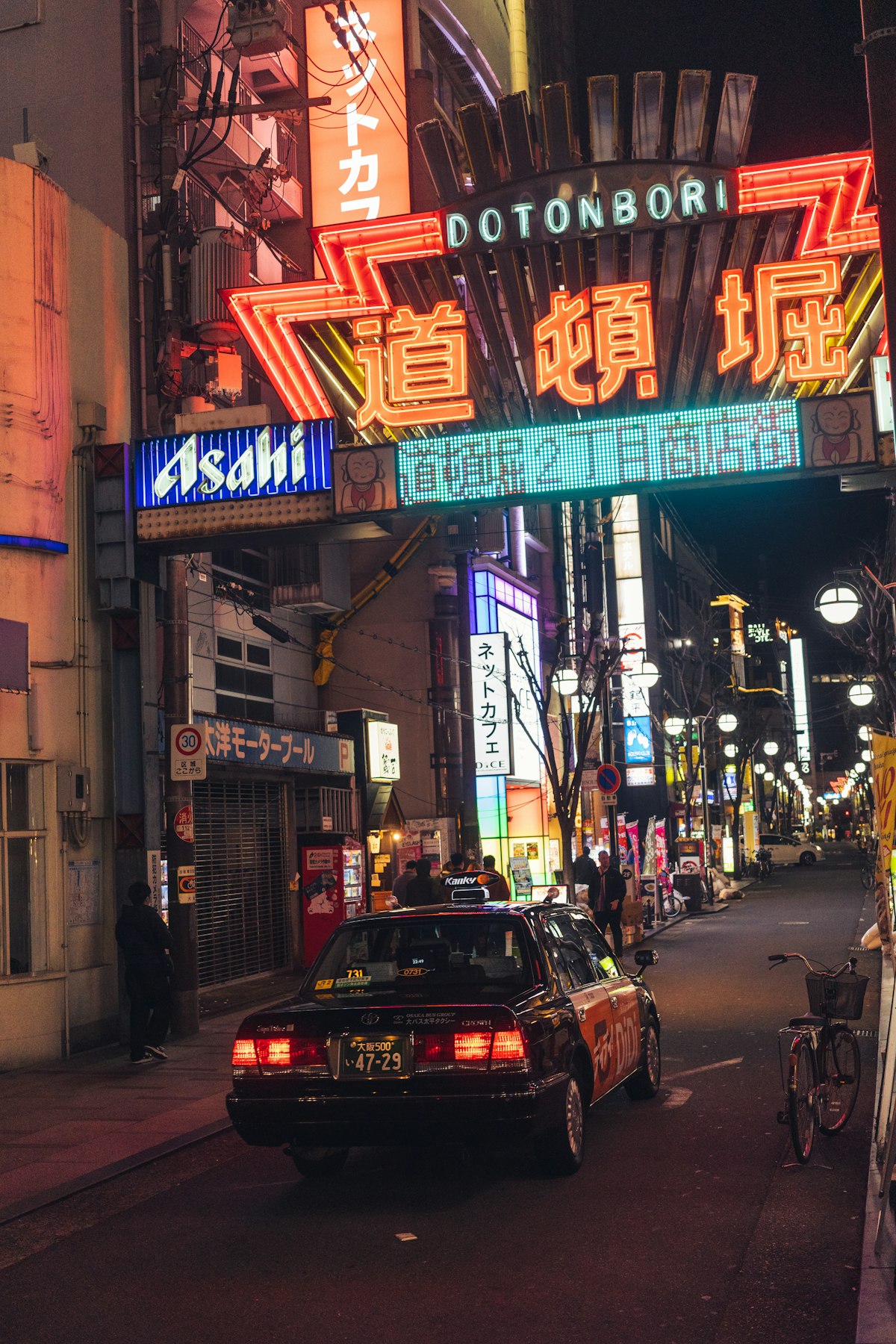
Osaka at night does not try to impress you. It feeds you, pours you a drink, and asks where you are from before you have taken your coat off. That single difference explains most of what follows.
Tokyo’s nightlife rewards research. You learn which floor of which building holds the bar you read about, you arrive, you behave correctly, and you are rewarded. Osaka’s nightlife rewards showing up. The streets are narrower, the signage is louder, the counters are smaller, and the person next to you is far more likely to start a conversation. Prices run noticeably lower than Tokyo for the same quality, especially on food and standing bar drinks.
It is also a compact night. Dotonbori, Namba, Shinsaibashi, Amerikamura, and Ura-Namba sit within a thirty minute walk of one another, and Kitashinchi is two subway stops north. You can eat in one district, drink in a second, and dance in a third without touching a train. Few cities this size let you do that.
This is our first Osaka guide and it is meant to be the hub: the drinking and clubbing scene, the hostess club tier, the licensed adult categories and where they cluster, the district every guidebook mentions and nobody explains properly, and the mechanics of cash, trains, and touts. For the nationwide picture, start with our complete guide to adult Japan and come back here for the Kansai specifics.
One note on what this guide will not do. Osaka’s adult scene is smaller, more locally oriented, and considerably less foreigner-friendly than Tokyo’s. Where a venue type is realistically closed to visitors who do not speak Japanese, we say so rather than pretending otherwise.
Quick Reference
- Core districts: Dotonbori (food and neon), Namba (clubs and late bars), Shinsaibashi and Amerikamura (cocktails and youth culture), Ura-Namba (hidden standing bars), Kitashinchi (upscale hostess clubs and members bars)
- Peak hours: 21:00 to 23:00 Friday and Saturday on Dotonbori; clubs peak around 01:00
- Typical spend: ¥5,000 to ¥8,000 budget night, ¥12,000 to ¥18,000 full night, ¥30,000+ premium (roughly $35 to $200 USD)
- Transit spine: Osaka Metro Midosuji Line, last trains around midnight
- Payment: Cash dominates at small bars and street food; cards fine at chains and clubs
- Foreigner-friendly: High for bars and clubs, mixed for kyabakura, low for the traditional adult districts
The Map of an Osaka Night
Think of the city’s south side as four rooms in the same house. Each one has a job, and each one takes over at a different hour.
Dotonbori is the front door. The 400 meter canal strip with the Glico running man sign is the most photographed stretch of neon in western Japan, and it is primarily a food district rather than a drinking one. Signs light at sunset, the crowd thickens from 20:00, and weekends peak between 21:00 and 23:00, according to Osaka’s tourism board. Takoyaki runs ¥600 to ¥800, ramen ¥1,000 to ¥1,300, and the Glico sign stays lit until midnight. By 01:00 the stalls shutter and the crowd drains south and west.
Namba, immediately south, is the engine room. Clubs, live houses, all night karaoke, and izakaya that do not care what time it is. Clubs open around 22:00 or 23:00, do not fill until after midnight, and run to 05:00 or 06:00 on Friday and Saturday. Entry typically costs ¥2,000 to ¥4,500, usually including a drink ticket. Turn up at 23:00 and you will have the floor to yourself.
Shinsaibashi and Amerikamura get interesting once the tourist crowd thins. Amerikamura is Osaka’s streetwear and indie music quarter, home to hip hop clubs and record shops; Shinsaibashi holds some of the most serious cocktail bars in the country, at ¥1,500 to ¥2,500 a drink. The crowd skews local, younger, and creative.
Ura-Namba, the lattice of alleys behind the main Namba drag, is the one locals actually recommend. Standing yakiniku counters, craft beer nooks, and izakaya with eight seats and no English menu. Two beers will cost you around ¥1,200. English is minimal here and nobody minds: point, smile, use a translation app, and you will be fine.
Kitashinchi is a separate world entirely. A twelve block grid just south of Umeda station, it is Osaka’s answer to Ginza: omakase counters, internationally ranked cocktail bars, members only clubs, and the city’s concentration of high end hostess clubs. The Osaka tourism board’s district guide puts cover charges at ¥800 to ¥3,000, cocktails at ¥1,500 to ¥2,800, and a full evening of dinner plus two bars at ¥18,000 to ¥30,000 per person. Unmarked doors here are not puzzles to solve. They are private.
A Timeline for a Good Osaka Night
18:00. Start with food, because in Osaka the eating is the night rather than a prelude to it. Kushikatsu in Shinsekai under the Tsutenkaku tower, or okonomiyaki near Namba. Shinsekai restaurants mostly close by 22:00, so this is the slot for it.
20:00. Walk the Dotonbori canal while the neon is at full strength and the crowd is still pleasant. Ebisu Bridge for the Glico photo. River cruises sail until about 22:00 for around ¥1,500.
21:30. Move into Ura-Namba for standing bars. This is the social peak of the evening, when strangers will talk to you and the counters are full but not crushed.
23:30. Decide. If you are catching a train, this is your cue: the Midosuji Line’s last services run around midnight in both directions, and there is no grace period. If you are staying out, commit properly.
00:30. Namba or Amerikamura clubs. Arrive now and you hit the floor as it fills rather than watching it fill.
05:00. The trains restart. All night karaoke boxes, at ¥1,500 to ¥2,500, exist mainly to bridge the five hours between the last train and the first, and plenty of locals use them exactly that way.
Drinking and Clubbing: What Things Cost and How to Behave
The standing bar, or tachinomi, is Osaka’s signature format. No seats, no cover charge, beer from around ¥500, food by the small plate. The cluster under the elevated tracks at Shin-Umeda Shokudogai has run essentially unchanged since the 1970s. Etiquette is simple: order promptly, do not hold a spot without drinking, and settle as you go.
Izakaya are the default sit down option, and this is where the one real bill trap lives. Nomihodai means all you can drink for a fixed period, typically 90 or 120 minutes, and it is usually a fair deal. The trap is the otoshi, a small compulsory appetizer that lands unrequested and adds ¥300 to ¥800 per person to the bill. It is not a scam. It is a seating charge in disguise and it is completely normal. Separately, table charges at bars you were led to by a tout are a different animal entirely, and those genuinely are predatory.
Clubs are straightforward. Bring photo ID, because door staff check it and a photo on your phone will not do. A passport is the safest bet; a residence card works if you have one. Entry includes a drink ticket more often than not, and drinks after that run ¥700 to ¥1,000. Live houses, the small venues where Osaka’s indie and punk scenes actually happen, charge a similar door fee plus a mandatory one drink purchase.
Cocktail bars deserve a note. The good ones in Kitashinchi and Shinsaibashi seat eight to twelve people, the bartender is the entire experience, and loud groups are unwelcome. Order one thing at a time and let the bartender lead.
The Hostess Side: Kitashinchi, Namba Kyabakura, and Girls Bars
Three tiers, three very different experiences, and the gap between them is mostly about money and access.
Kitashinchi is the top. Hostess clubs here operate on the Ginza model: a regular customer base, introductions, set charges that start high and climb through drinks bought for the table and for the hostess, and a bottle keep system that assumes you are coming back. Many venues are functionally members only. A first visit without an introduction is possible at some clubs but you should expect ¥20,000 to ¥40,000 and up per person for a straightforward set, and the language barrier is real. Book through a hotel concierge if you want to try.
Namba and Shinsaibashi kyabakura are the mainstream tier. Set charges commonly run ¥4,000 to ¥8,000 for the first 40 to 60 minutes, plus drinks for yourself and for the hostess, plus service charge and tax. A realistic first visit lands between ¥10,000 and ¥20,000. The mechanics are identical to Tokyo’s, so our Tokyo hostess club guide translates directly: the system, the extension charges, and the etiquette are the same.
Girls bars are the entry point and the best value by a wide margin. You sit at a counter, a staff member on the other side of it pours your drinks and talks to you, and you pay by the hour rather than for a table. Expect ¥3,000 to ¥5,000 per hour all in. Nothing happens beyond conversation, and that is the point. Our girls bar guide covers the format and the pricing traps in detail.
One warning specific to Osaka. The “snack bar” invitation offered on the street near Dotonbori and Don Quijote is the single most common way visitors get overcharged in this city. Legitimate hostess venues do not recruit passing tourists off the pavement. If someone approaches you with a laminated menu and a price that sounds too good, walk.
The Adult Side: Licensed Categories and Where They Cluster
Japan’s adult industry operates under a licensing regime that permits a defined set of service categories while prohibiting others outright. The categories are national, so the vocabulary you learn in Tokyo works in Osaka. What changes is the geography and, crucially, the foreigner policy.
Soapland venues are the premium tier, built around an elaborate bathing ritual in a private room. In Osaka they concentrate in the Kanzaki district in nearby Amagasaki and in pockets around Tobita, rather than in one central quarter the way Yoshiwara serves Tokyo. Our soapland guide explains the format, the pricing tiers, and what actually happens from arrival to departure.
Delivery health, or deriheru, is the largest category nationally and the most practical one for visitors, because the service travels to your hotel or a love hotel rather than requiring you to find a shopfront. It is also the category where English language booking has improved fastest. Read our delivery health guide before booking anything, particularly the section on hotel policies, since many business hotels in Osaka refuse deliveries outright.
Pink salons, image clubs, and fashion health occupy the middle of the market and cluster around Nipponbashi and the eastern edge of Namba. Kyabakura and girls bars we covered above. For the full taxonomy with Japanese terms and what each one does and does not include, see our complete fuzoku guide.
Here is the honest assessment. Osaka’s adult venues are overwhelmingly oriented toward domestic customers, and refusal of non-Japanese customers is common and legal. Tokyo has an established cluster of venues that actively market to foreign visitors; Osaka does not, or at least not at comparable scale. If foreigner access is your priority, our directory of foreigner-friendly venues is currently Tokyo focused, and our Tokyo venue rankings reflect that reality rather than an editorial preference. Plan Osaka for the nightlife and Tokyo for the rest.
If you do book anything, understand the love hotel system first, because it underpins a large share of how this works logistically. Our love hotel guide explains rest rates versus stay rates, the panel selection system, and the check in mechanics, all of which work identically in Osaka.
Tobita Shinchi: What It Is and Why It Is Not a Tourist Stop
Every Osaka listicle mentions Tobita Shinchi and almost none of them handle it responsibly, so here is the straight version.
Tobita Shinchi, in the Sanno district of Nishinari ward, was established in 1912 after a fire destroyed the older Namba Shinchi quarter. It is the largest district of its kind in western Japan. After the 1958 Prostitution Prevention Law, its establishments reregistered as ryotei, traditional Japanese restaurants, and operate under a local legal interpretation in which tea and snacks are served in a private room and anything subsequent is treated as a private matter between adults. Roughly 160 houses belong to the local restaurant association. Women sit in the open doorways of wooden shopfronts, lit from above, with an older woman seated beside them.
It is a remarkable piece of urban history, and it is also somebody’s workplace and somebody’s neighborhood. Photography is not tolerated and people have been confronted for attempting it. Many houses decline customers who are not fluent Japanese speakers, a policy that predates the tourism boom. The surrounding Nishinari area is Osaka’s poorest and, while not dangerous in the way visitors imagine, is not improved by tourists filming it.
Treat it as context for how Japan’s postwar legal compromise works on the ground, not as a stop on an itinerary, and do not point a camera at it. We are not going to explain how to use the district, because the people who live and work there have made it clear they do not want that traffic.
What Changed in 2026
The Expo hangover turned out to be an upgrade. Expo 2025 left Osaka with events that outlived it. The OSAKA River Fantasy musical fountain at Hachikenyahama on the Okawa River, roughly 100 meters of water jets synchronized to music and projection mapping, launched in March 2025 and has been extended well past its original run. Shows run on the hour and half hour through the evening and cost nothing to watch.
Crowds are high but no longer climbing. Japan took 42.68 million foreign visitors in 2025, an all time record. The first half of 2026 brought around 21.1 million, down about two percent year on year and the first decline in five years, while July 2026 still set a record for the month at roughly 3.44 million. The practical translation for your night out: Dotonbori is as busy as it has ever been on a Saturday, but the frantic scarcity of 2025 has eased. Restaurant reservations are easier and hotel rates have softened slightly outside peak weeks.
Prices have drifted up, unevenly. Street food and standing bars absorbed inflation better than sit down restaurants and clubs. A ¥500 beer is still a ¥500 beer; club entry and cocktails have moved more.
Street solicitation is under national scrutiny. A government expert panel has recommended amending Japan’s 1956 Anti-Prostitution Law to penalize buyers as well as sellers, on the street and online, closing an asymmetry that currently punishes only the person soliciting. Police attention has intensified nationwide as a result. Licensed venues operate under a separate framework and are unaffected, but anyone approached on the street is not. We cover the proposal in Japan’s move to punish sex buyers.
Practical Checklist
Cash. Carry ¥15,000 to ¥20,000 per person for a full night. Standing bars, street stalls, small counters, and most adult venues are cash only. The 7-Eleven ATM is the most reliable machine for foreign cards, and there is one roughly every three blocks in central Osaka.
Trains. The Midosuji Line is the spine and it stops around midnight, with last services from Umeda and Namba falling somewhere between 23:45 and 00:20 depending on direction and destination. Check your specific last train before you commit to a second venue, because the difference between 23:47 and 00:11 is a ¥3,000 taxi.
Taxis. Plentiful and honest, at ¥1,500 to ¥3,000 from Namba to a central hotel. Drivers rarely speak English, so show the address in Japanese on your phone. Card payment is standard.
Touts. The single most useful rule in Osaka: never accept an invitation from someone who approached you on the street. This applies to the lanes between Dotonbori’s west end and the Sennichimae arcade, the blocks around Don Quijote, and the Amerikamura fringes. Touting for these venues is itself illegal in much of the country, which tells you what kind of business is doing it.
ID. Carry your passport or residence card. Clubs check, some bars check, and every adult venue checks. Photocopies and phone photos are routinely refused.
Language. English is good at clubs, chain izakaya, and hotel bars, patchy at cocktail bars, near zero at standing bars and adult venues. A translation app and a willingness to point covers almost everything. Osaka people are notably more forgiving of bad Japanese than Tokyo people are.
Safety. Osaka is very safe by any international standard, and our nightlife safety guide covers the scams that do exist. The threats here are financial rather than physical: inflated tabs, fake cover charges, and bars that will not let you leave until you settle. Choose your own venues and none of it happens.