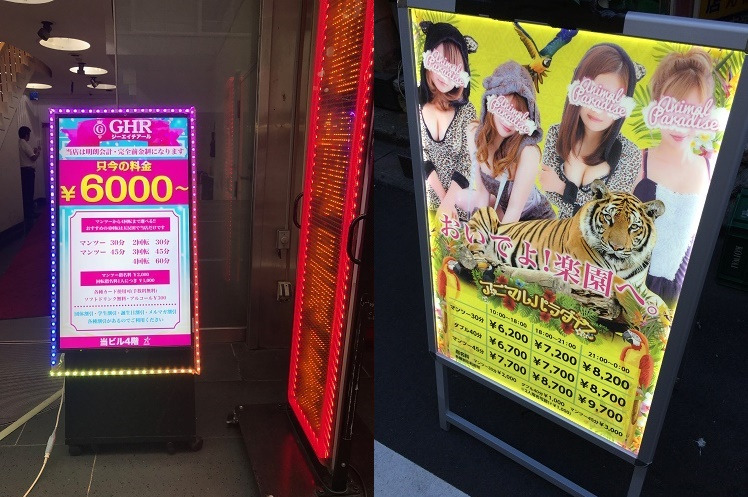
Walk past a certain kind of building in Ikebukuro or Osaka's Kyobashi and you will see a hand-lettered board at street level quoting a number like 3,500 and a time like 20 minutes, with no explanation of what either refers to. That board belongs to a pink salon, and the reason it is so coy is not marketing. It is a licensing problem, and understanding that problem explains almost everything strange about how these places operate.
Quick Reference
- What it is: Oral service at a seat in a dimly lit bar, with a drink included
- 2026 price: ¥3,500 (15–20 min) to ¥12,000 (45 min), most sessions ¥5,000–7,000
- License: Category-one hospitality drinking business, the same class as a hostess club
- Closing time: Midnight in most of Japan, 1:00 AM in some designated zones
- Where: Ikebukuro, Otsuka, Sugamo, Gotanda, Kabukicho, Kinshicho; Kyobashi in Osaka
- Foreigner-friendly: Poor. A minority of venues accept foreign customers
- Booking: Walk-in, cash only, no phone reservations at most venues
What a pink salon actually is
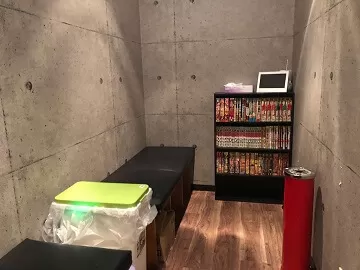
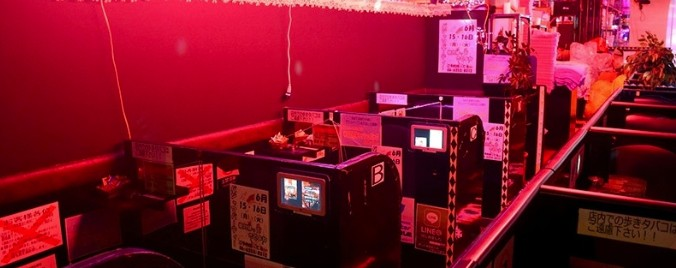
A pink salon, shortened in Japanese to pinsaro (ピンサロ), is a bar where the entertainment is oral service. You pay a fixed fee at the counter, you are shown to a bench seat or a low-partitioned booth in a dark room, a member of staff joins you with a drink, and a timer starts. When the timer ends, she leaves. The whole visit often takes less than half an hour from door to door.
The format dates to the 1960s, when venues were advertised as pink cabarets or negligee salons and the service was limited to touching. Oral service was folded in later, and the modern pinsaro settled into the shape it holds today. The word pink has long been Japanese shorthand for erotic, as in pink films, and it stuck to these venues the way it stuck to the film genre.
Two things surprise first-time visitors. The first is how public it feels, because the partitions between seats are low enough that you are aware of other customers. The second is how fast it is. A pink salon is not an evening out. It is a transaction measured in minutes, and every design choice in the room serves that pace.

Why a pink salon is legally a cabaret
Here is the part almost every English-language guide gets wrong. A pink salon is not licensed as a sex business. It holds a category-one permit under the Businesses Affecting Public Morals Regulation Act, usually shortened to fueiho, which is the same category that covers hostess clubs and host clubs. In official language it is a social drinking establishment offering hospitality, and a Yamaguchi District Court ruling in 1996 accepted that hospitality can stretch to sexual service under that permit.
Operators chose that route because the other one closed. The 1985 overhaul of the fueiho froze new store-based sex businesses out of most zones in Japan, so anyone opening after that date could not simply file a notification the way a soapland or a fashion health shop had done. Applying for a drinking license was the door that stayed open. Note the difference in mechanism as well: a sex business files a notification, while a category-one venue needs actual authorization from the prefectural public safety commission.
That choice carries consequences the customer feels directly. Category-one venues may not install partitions, screens, curtains, or chairs roughly one meter or taller that block the line of sight across the customer area. The room also has to stay above five lux of illumination, which is why pink salons are dim rather than dark, and why police have shut venues down over lighting alone. A pink salon advertising a fully private booth is either exaggerating or operating outside its license.
Closing time is the other visible effect. Category-one businesses generally cannot trade between midnight and 6:00 AM, with some prefectures permitting 1:00 AM in designated entertainment zones. That is why a pink salon shuts hours before the soaplands and delivery health services around it. For how these categories fit together, see our complete guide to fuzoku categories.
The legal exposure nobody mentions
Because the law treats a pink salon seat as a space in public view, raids are not usually charged as licensing violations. Prosecutors reach instead for Article 174 of the Penal Code, public indecency, which carries up to six months imprisonment or a fine of up to ¥300,000. Tokyo police brought the first such charge against a pink salon in Ueno in May 2021, arresting eight people, and repeated it in Kamata in June 2022 with four arrests. In both cases a male customer was among those detained.
Do not read that as a reason to panic. Enforcement is infrequent, it targets operators, and hundreds of thousands of visits pass without incident. Read it instead as a reason to avoid venues that look like they are pushing their luck, meaning anywhere advertising full service, anywhere using street touts, and anywhere that seems to be trading after the legal closing hour.
The broader legal ground also shifted in 2025 and 2026. The fueiho amendment that took effect on June 28, 2025, with a second phase on November 28, 2025, raised the penalty for unlicensed operation from two years and ¥2 million to five years and ¥10 million for individuals, and to ¥300 million for companies. It also added conduct rules across hospitality drinking businesses, the class that includes pink salons, banning intimidation over payment, exploiting a customer's romantic feelings to run up a bill, and serving items the customer did not order.
Separately, a Justice Ministry panel reported on September 17, 2026, recommending that buyers of sex be penalized. That proposal targets street and online solicitation, not licensed venues, and nothing has been enacted. We cover it in detail in our explainer on Japan's 2026 sex-buyer proposal, and the underlying statute in is prostitution legal in Japan.
Pink salon prices in 2026
Pink salons remain the cheapest hands-on option in Japan's adult industry, and the gap has widened as other categories raised prices. The numbers below reflect posted rates in 2026. Figures in dollars assume roughly ¥150 to the dollar and will drift with the exchange rate.
| Course | Price | Approx. USD | Notes |
|---|---|---|---|
| 15–20 min (budget) | ¥2,500–4,000 | $17–27 | Otsuka, Sugamo, Kyobashi; open seating, fast rotation |
| 25–30 min (standard) | ¥4,500–7,000 | $30–47 | The default course; Ikebukuro, Gotanda, Kabukicho |
| 40–45 min (long) | ¥8,000–12,000 | $53–80 | Often sold with hanabira rotation |
| Nomination (shimei) | ¥0–1,000 | $0–7 | Free at many venues; not always available |
| Membership (nyukaikin) | ¥0–1,000 | $0–7 | First visit only; often waived with a coupon |
| Extension (enchou) | ¥1,000 per 10 min | $7 | Arrange before the bell, not after |
Regional averages for a 30-minute course diverge sharply. Kanto is the most expensive at roughly ¥6,000, Kansai sits near ¥5,000, Hokkaido and Tokai around ¥4,000, and Kyushu is the cheapest at about ¥3,500. Osaka's Kyobashi cluster undercuts Tokyo noticeably, with several venues posting 20-minute courses from ¥3,500.
One charge catches people out. The drink is part of the license, not a courtesy, so an order is effectively mandatory. A soft drink is normally covered by the base fee, but alcohol is billed separately at most venues and is not on the street-level board. If you want a beer, ask the price at the counter rather than at your seat. For how pink salons compare with other cheap options, see our guide to Tokyo adult entertainment under ¥10,000.
The rotation system, explained properly
Kaiten (回転) means rotation, and it is the engine of the business model. Staff do not stay with one customer for an evening. They cycle between seats on a timer, which is how a venue can sell a 20-minute course at a price no other category can match. Your clock starts when she sits down, not when you walk through the door, so a long wait in the lobby does not eat into your paid time.
A separate product confuses people. Hanabira kaiten (花びら回転), literally flower-petal rotation, means two or three different staff members rotate through your single session. Venues market it as a three-rotation or five-rotation course. It is not an upgrade in intimacy. It is a volume offer, and it suits people who want variety more than conversation.
Near the end of your time you will hear a bell or a call of hana no jikan (花の時間), flower time, meaning a few minutes remain. That is your cue. Extensions have to be arranged with staff before the session ends, not negotiated afterward, and the rate is roughly ¥1,000 per ten minutes.
What is and is not on the menu
Oral service is the product. Kissing, touching, and hand service are usually included. Depending on the venue and the staff member, mutual play such as fingering or oral given to her may be available, which is why venues check your fingernails at the counter. Trimmed nails are a hard requirement at many places.
Penetrative sex is not offered and asking for it is the fastest way to be removed. Male floor staff patrol the room specifically to prevent it, and a venue caught selling it loses far more than a fine. Soaplands are the only store-based category where the full experience is the understood product, and we cover the legal fiction behind that in our Tokyo soapland guide.
Be realistic about the assignment as well. Staff on their period will restrict what is available, and under the rotation system you do not get a preview. Nomination, where offered, is the only lever you have over who sits down.
Hygiene realities
Pink salons sit at the lower end of Japanese adult-industry hygiene, not because venues are careless but because the format allows no shower. You clean up with a hot towel at the seat, and that is the extent of it. Mouthwash is provided and usually expected before the session starts.
Protection practice varies and is not standardized. Some venues supply and require it, some leave it to the staff member, and a few treat the request as unusual. Carrying your own is the only reliable approach, and no receptionist will think twice about it. Oral transmission of several infections is a real risk here, which is why experienced visitors treat pink salons as an occasional novelty rather than a routine.
Where pink salons survive in 2026
The category has been shrinking for a decade. Venue counts are down across every major Tokyo pink salon district compared with ten years ago, and the survivors trade more quietly than they once did. Higashi-Jujo lost all of its venues in 2020, Ueno and Shibuya are down to a handful, and Kichijoji's scene has largely dissolved as the neighborhood gentrified.
What remains clusters in a few places. Ikebukuro is the strongest Tokyo area and the usual recommendation for a first visit, with several chains operating multiple branches. Otsuka and Sugamo, one and two stops away on the Yamanote Line, hold the budget end. Gotanda keeps a traditional scene with heavy use of rotation and concept themes. Kabukicho in Shinjuku mixes decades-old venues with newer school-themed ones. Kinshicho, Koenji, Ogikubo, Akabane, and Kamata each retain a working cluster, and Kawasaki, Funabashi, and Tachikawa serve the surrounding prefectures.
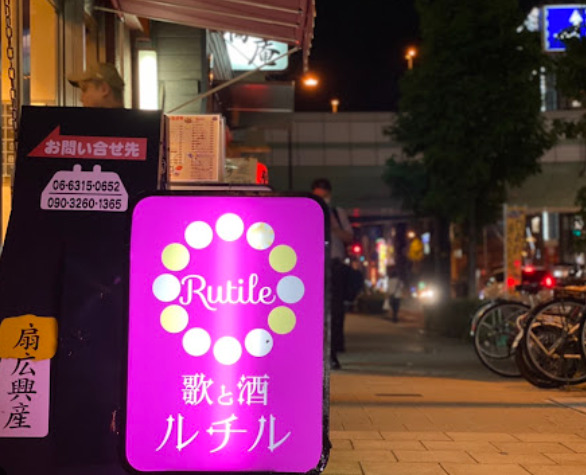
Outside the capital, Osaka is the other real market, and it is concentrated in Kyobashi rather than Namba or Shinsaibashi, which have essentially none. Nipponbashi and Sakai-Higashi hold a few more. Kyobashi is roughly five minutes on foot from the JR and Keihan station exits, and the cluster is dense enough that comparing boards is practical.
Foreigner acceptance in 2026
This is the blunt part. Pink salons are the least welcoming category in Japan's adult industry for foreign customers, and that has not improved. The reasons are structural rather than personal. A 20-minute session leaves no room to work through a language barrier, the payment and rotation system genuinely confuses newcomers, and a venue that gets it wrong absorbs the cost in wasted rotation slots.
A minority of venues do accept foreign customers. In Tokyo these cluster in Ikebukuro and Sugamo, and in Osaka around Kyobashi. Some of them price accordingly, so expect to pay above the board rate at venues that specialize in foreign clientele. Bringing a Japanese-speaking friend changes the reception at a surprising number of places.
Being refused at the counter is normal and is not worth arguing about. Staff will usually say gaikokujin no kata wa gomennasai, meaning foreign customers are not accepted. Thank them and move on. Check a venue's stated policy first using our foreigner-friendly venue guide or the venue directory, and note that the directory is Tokyo-focused. The community-maintained Tokyo Night Style wiki also tracks which venues admit foreigners.
Scams and pressure tactics
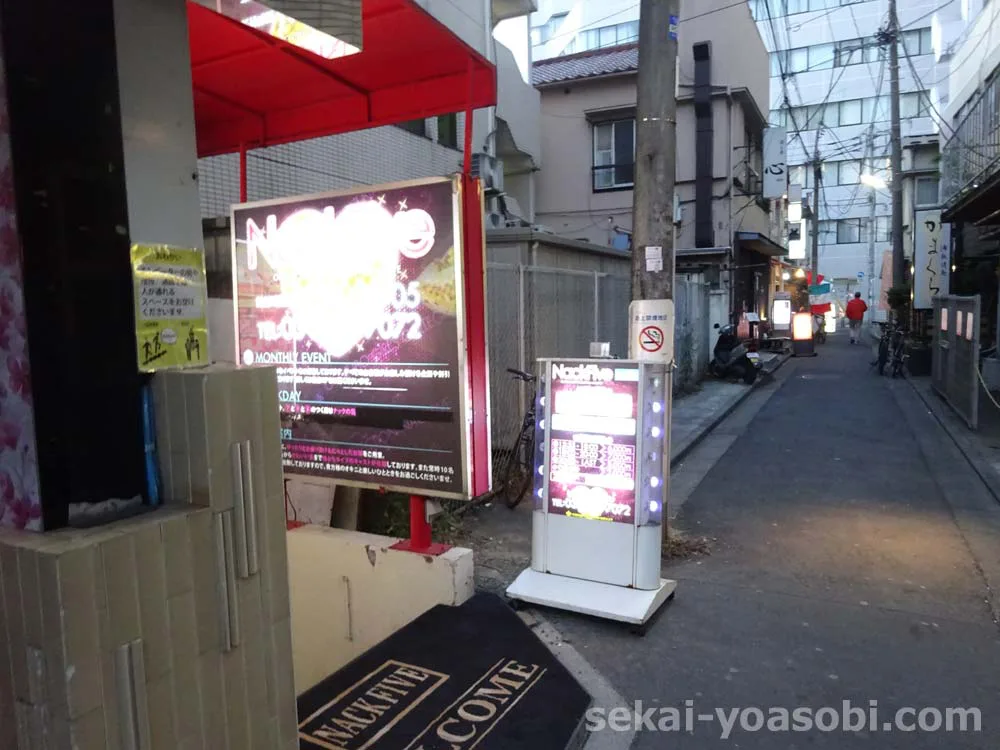
Street touts. Anyone approaching you on the street offering to walk you to a pink salon is a red flag, not a convenience. Street soliciting for adult venues is banned by ordinance in Tokyo and Osaka, so a venue using touts is already operating outside the rules. Tout-fed venues are where the inflated bills happen.
Boards that quote the floor, not the total. The number on the street sign is the base course for a first-time customer in the cheapest time slot. Membership, nomination, alcohol, and time-band surcharges can add several thousand yen. Ask for the total at the counter before you hand over cash, and say zenbu de ikura desu ka, meaning how much in total.
Extension pressure at the bell. A staff member who raises an extension in the final minutes is doing her job, but the decision is yours and the answer no thank you is complete. Never agree to an extension at your seat without knowing the price. Post-session billing disputes are exactly what the 2025 fueiho conduct rules were written to address.
Anywhere advertising full service. A pink salon offering penetration is either lying to get you inside or operating illegally enough that a raid is a live possibility. Neither outcome is good for you.
Etiquette and your first visit
Bring cash. Effectively no pink salon takes cards, and ¥10,000 covers a session with room for extras. Shower before you leave your hotel, use mouthwash, and trim your nails. Wear something easy to open, because the seats are small and the clock is running.
At the counter, point at the board and hold up fingers for the course length. Pay before you go in. Once you are seated, your phone stays away, since photography rules are strictly enforced and reaching for a phone reads as filming. Do not touch her head or hair while she is working, do not haggle, and do not arrive drunk, which is the most common reason customers are turned away.
Warn her before you finish by saying iku, which functions here as a courtesy rather than a performance. Afterward, wipe down with the towel, dress, and leave when she does. Tipping is not a custom in this category and pressing money on someone creates awkwardness rather than goodwill.
Pink salon glossary
Pinsaro (ピンサロ) is the abbreviation to use when searching Japanese listings. Shimei (指名) is nomination, priced between free and ¥1,000, while furii (フリー) means taking whoever the rotation assigns at no charge. Kaiten (回転) is the rotation, and hanabira kaiten (花びら回転) is the multi-staff version. Enchou (延長) is an extension, uketsuke (受付) the reception counter, nyukaikin (入会金) a one-time membership fee, and kihon kosu (基本コース) the standard course a first-timer should ask for.
Essential Japanese Phrases
The verdict for 2026
A pink salon is the cheapest and fastest hands-on experience in Japan's adult industry, and for a certain kind of visitor that is the appeal. It is also the least private, the least hygienic, the least foreigner-friendly, and the one on the least comfortable legal footing. Those trade-offs all flow from the same decision to operate under a drinking license rather than a sex-business notification.
If you want the format, go on a weekday afternoon in Ikebukuro or Kyobashi, pick a venue with a clearly posted board and no tout outside, bring cash and your own protection, and treat the sign price as a starting point. If privacy or hygiene matters more than price, a soapland or a delivery health booking is better value. For the wider picture, see the cultural context behind Tokyo's pink salons.